 PalworldZone
Palworld Work Suitability in 2026: The Invisible Choreography Behind Every Base
Palworld's Palpagos Islands have always rewarded wanderlust, but in 2026 the game's most demanding audience may be the base itself. Pocketpair's creature-collecting survival hit continues to push players to capture Pals, yet the real test of mastery begins after the capture. At a player's base, structures offer crafting capabilities, and while many facilities can be operated manually, the true efficiency comes from employing captured Pals through Palworld's Work Suitability system.
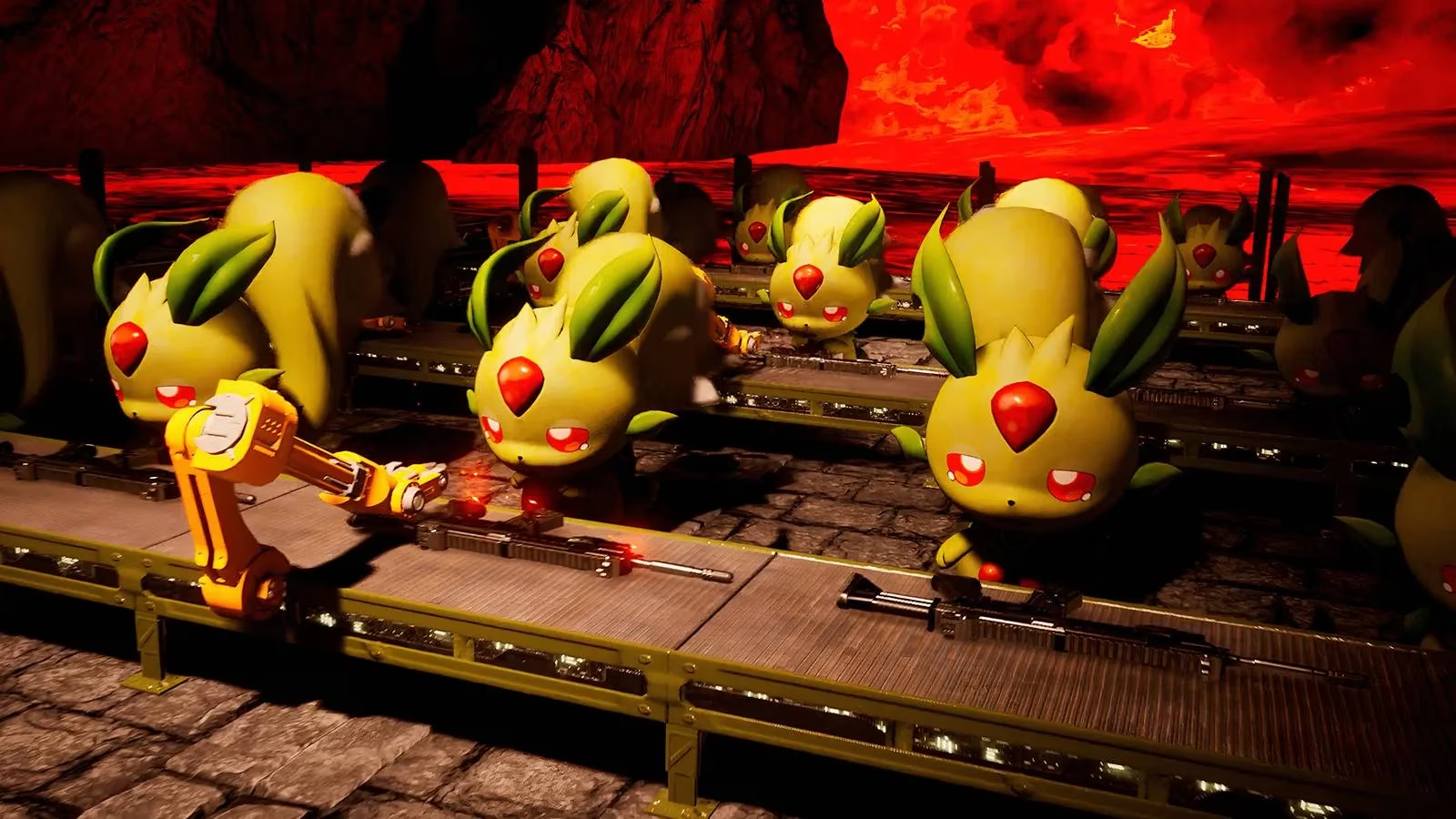
Work Suitability is less a blunt hammer than a locksmith's ring of precise keys. Each captured Pal arrives with a unique set of traits, and those traits determine exactly which base tasks the creature can perform. There are twelve Work Suitability traits in total, and a single Pal may possess anywhere from one to five of them, with some species possibly even exceeding that range. The traits are static for each species, so two Pals of the same kind will not surprise players with different labor profiles. For details, players can consult the Paldeck in the main menu, which serves as Palworld's equivalent of a Pokédex.
| Work Suitability | Typical base function |
|---|---|
| Kindling | 🔥 Fuels furnaces, cooking, and smelting |
| Planting | 🌱 Sows seeds at plantations |
| Handiwork | 🔨 Assists crafting benches and production |
| Lumbering | 🪓 Cuts trees for wood |
| Medicine Production | 💊 Creates medicines |
| Transporting | 📦 Moves items between containers |
| Watering | 💧 Operates crushers and irrigates crops |
| Generating Electricity | ⚡ Powers generators |
| Gathering | 🧺 Collects crops from plantations |
| Mining | ⛏️ Extracts ore and stone |
| Cooling | ❄️ Preserves food and supports cooling stations |
| Farming | 🐄 Produces resources at ranches |
The system comes with a slight learning curve. Simply memorizing which Pals can work at which stations can take time. Most crafting stations' Work Suitability requirements can be seen in the Build menu, but the most efficient way to confirm a requirement is to build the station and approach it. A line of text will appear above the station, indicating the trait it needs. Some stations, such as the Primitive Workbench or High Quality Workbench, can be operated by either the player or a Pal with Handiwork. Others, such as the Crusher, can only be operated by a Pal with Watering.
Assigning labor is straightforward once the required trait is known. A player submits an order at a crafting station and ensures a Pal with the correct Work Suitability has been retrieved from the Palbox. The Pal then automatically gets to work once the order is submitted. In this way, the Palbox functions like a casting director's call sheet for a silent film: the right performer must be available, or the scene simply cannot proceed.
The result is a base that becomes a living clockwork garden. Each Pal is a gear with teeth shaped only for certain tasks, and a missing trait can stall an entire production line. A player may have an army of powerful combat Pals, yet without a Watering specialist, the Crusher remains idle. Without Transporting, resources pile up in the wrong places. Without Kindling, furnaces grow cold. These dependencies create interesting dynamics that many other base-building games do not have in their core mechanics.
Palworld's Work Suitability system may take time to get used to, but it rewards planning. It encourages players to find and capture Pals of all kinds, not merely the strongest fighters. Exploration becomes more valuable because every new species is a potential solution to a base bottleneck. In 2026, as Palworld continues to evolve, the Work Suitability system remains one of the clearest examples of how Pocketpair blends creature collection with production management. The Palpagos Islands are dangerous, but a well-managed base proves that the right Pals can turn chaos into a well-oiled, well-managed workspace.
Comments