 PalworldZone
Victor Ashford: The Mad Scientist and His Ambitions in Palworld's Palpagos Islands
In the treacherous, faction-riven world of Palworld's Palpagos Islands, few figures are as enigmatic and driven as Victor Ashford. Hidden away in the archipelago's frosted peaks, this reclusive leader of the PAL Genetic Research Unit represents the cold, uncompromising edge of scientific ambition. While other factions clash over territory and ideology, Ashford's war is waged in the laboratory, a relentless pursuit to bend the very essence of life to his will. His story, pieced together from scattered diary entries and the grim results of his work, reveals a man for whom the end—creating the ultimate lifeform—justifies any means. As the last faction leader players are likely to encounter, understanding Victor Ashford is key to grasping one of the darkest threads in Palworld's rich tapestry.
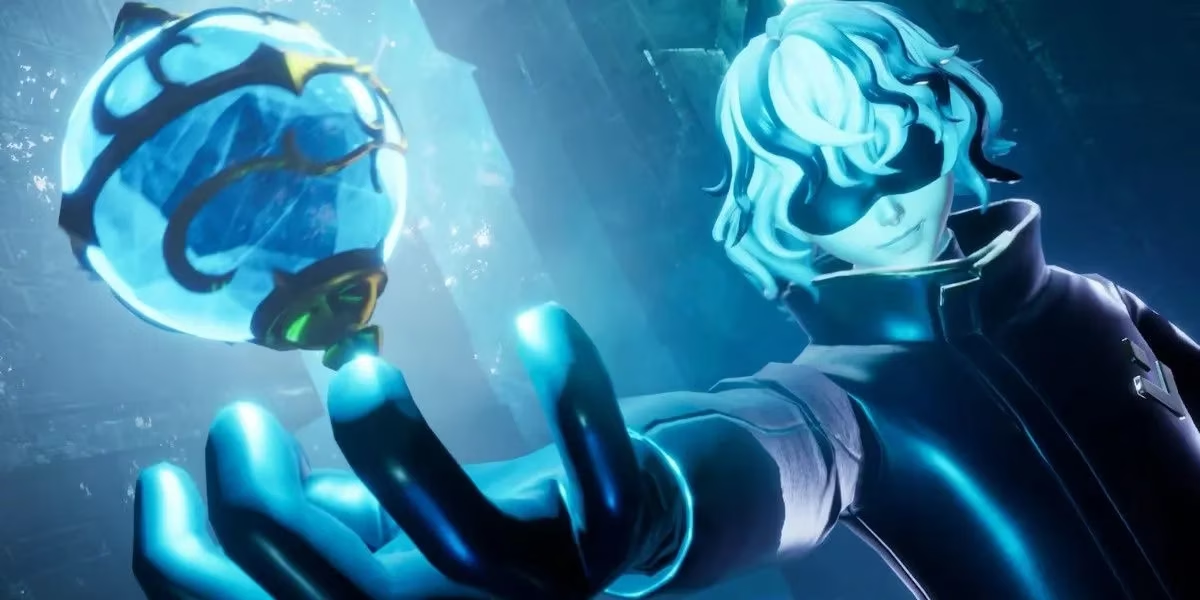
Victor Ashford is, at his core, a man of science, but his methodology is where morality dissolves. He leads the PAL Genetic Research Unit with a singular, chilling focus: genetic manipulation to forge the perfect being. His ambitions aren't merely academic; they are transformative, seeking to create bioweapons and Pals of unprecedented power through splicing and breeding. This pursuit casts him in the classic role of the mad scientist, isolated in his mountain fortress, where the wails of failed experiments are as common as the howling wind. A significant hurdle in his work is technological stagnation. All his advanced equipment originates from the outside world, making upgrades and improvements nearly impossible. This limitation forces him into a cycle of improvisation with flawed tools, a constraint that perhaps fuels both his frustration and his dangerous ingenuity.
The heart of Ashford's operations lies in his experiments, a chronicle of ambition paved with failure. His diary entries detail a relentless quest to create new life by forcibly combining various Pals. One early goal was to engineer a four-legged Pal with functional wings—a chimera of terrestrial and aerial prowess. Yet, time and again, these combination patterns resulted in catastrophic failure. The outcomes were often grotesque and unstable; some hybrids formed physical bodies only to immediately deteriorate, becoming nothing more than biological waste to be disposed of. These repeated setbacks, however, did not deter him. They instead sharpened his resolve, pushing him to seek more radical methods.
A turning point came with the extraction of specific chemicals and High-Quality Pal Oil. This breakthrough marked a shift from crude physical splicing to a more insidious form of enhancement. Ashford discovered he could amplify a Pal's abilities by liquifying one Pal and injecting its essence into another. This process represented a darker, more refined form of his genetic tampering, moving beyond external hybridization to internal, fundamental alteration. It was through this grim alchemy that his first true success was born, though it came with a heavy price.
That success was Shadowbeak, a Pal that stands as a testament to Ashford's vision and the horrific cost of achieving it. Shadowbeak emerged as a powerful entity, likely the embodiment of the "ultimate lifeform" Ashford sought. Yet, the victory was bittersweet and isolated. The exact procedure that created Shadowbeak proved irreplicable, a fleeting moment of success in a sea of variables Ashford could not control. Furthermore, the experiment's notes contain a haunting footnote: Ashford's lab assistant, Alex, went missing during the process. This disappearance adds a layer of profound mystery and suggests that the creation of Shadowbeak may have required a sacrifice beyond mere Pal fluids—a human cost that Ashford's notes chillingly omit to elaborate on.
Ultimately, Victor Ashford's legacy in the Palpagos Islands is a complex one. He is not a conqueror seeking land, but an ideologue seeking to conquer nature itself. His faction, the PAL Genetic Research Unit, operates on a plane separate from the territorial squabbles of others, yet its work has the potential to irrevocably alter the ecosystem and power balance of the entire archipelago. He is a reminder that in Palworld, the greatest threats are not always the most obvious armies, but the quiet, relentless pursuits of knowledge stripped of ethics. As of 2026, his frozen lab remains a site of both terrifying potential and tragic failure, a monument to one man's dream of playing god with the building blocks of life in a world already teeming with it.
Comments